

Navigator pear refers to a context-dependent term used to describe a structured navigation concept, tool, or framework. It is typically associated with systems that organize, map, or guide information efficiently. Its meaning varies by industry, often relating to digital navigation, data structuring, or user experience optimization processes.
Navigator pear is not a universally standardized term. Instead, it is interpreted based on context, industry usage, and application environment. In most cases, it relates to:
- Structured navigation systems
- Information mapping frameworks
- Digital or analytical tools
- User-guided pathways in systems
From an SEO and semantic perspective, “navigator pear” behaves like a low-clarity keyword, meaning:
- It lacks a fixed definition
- It may represent a niche tool, internal system, or branded concept
- Search engines attempt to interpret it using contextual signals (Based on search behavior analysis…)
Origin and Context of the Term
The phrase “navigator pear” does not originate from a widely recognized academic, technical, or commercial standard. Instead, it appears to be:
- A compound keyword
- Potentially derived from:
- “Navigator” (guidance, direction, system flow)
- “Pear” (could be symbolic, brand-related, or acronym-based)
Contextual Breakdown Table
| Component | Meaning | Application Context |
|---|---|---|
| Navigator | Guidance, routing, system flow | Software, UX, data systems |
| Pear | Undefined / symbolic / brand-specific | Product naming, internal frameworks |
| Combined Term | Structured navigation concept | Digital systems, tools, frameworks |
Key Insight:
The ambiguity suggests that “navigator pear” may be:
- A branded internal system
- A misinterpreted or emerging keyword
- A semantic variation of a known concept
Why Navigator Pear Is Gaining Attention
Despite unclear origins, the keyword is gaining traction due to:
- Increased searches for navigation-based systems
- Growth in UX design and information architecture
- Expansion of AI-driven data mapping tools
Key Drivers
- Rising demand for structured digital experiences
- Complexity in data systems requiring navigation frameworks
- Growth of platforms developed by companies like Google and Microsoft
Quick Takeaway:
- Navigator pear is not a fixed concept
- Its meaning depends on context and usage
- Most relevance lies in digital systems and structured navigation
Key Interpretations of Navigator Pear
Understanding navigator pear requires analyzing how it is interpreted across different domains.
Navigator Pear as a Concept
In a conceptual sense, navigator pear can refer to:
- A framework that guides users through structured information
- A logical mapping system
- A decision-making pathway
Concept Characteristics
- Organized structure
- Sequential navigation
- Data-driven pathways
- User-centric design
This aligns closely with principles of:
- Information Architecture
- User Experience (UX) Design
- System Navigation Models
Navigator Pear in Technology or Software
If interpreted as a digital or software-related term, navigator pear may represent:
- A navigation module within software
- A UI/UX navigation framework
- A backend data routing system
Functional Components Table
| Component | Function |
|---|---|
| Navigation Layer | Directs user flow |
| Data Mapping | Organizes system data |
| Interface Layer | Displays navigation paths |
| Logic Engine | Processes navigation decisions |
Industry Insight:
Modern platforms developed by Google often rely on advanced navigation frameworks that resemble such conceptual structures (Based on UX system standards…).
Discover more about BagelTechNews.com Tech Headlines – Latest Tech News, AI & Trends
Possible Product or Brand Associations
Another interpretation is that navigator pear may be:
- A product name
- A tool or SaaS platform
- An internal system used by organizations
Indicators of Brand Association
- Unique keyword structure
- Low competition but specific phrasing
- Potential proprietary usage
However, due to limited public documentation:
- No verified global product exists under this exact name
- It may be region-specific or newly emerging
Industry-Specific Meanings
Different industries may interpret navigator pear differently:
Industry Mapping Table
| Industry | Possible Meaning |
|---|---|
| Technology | Navigation framework or system |
| Data Analytics | Data mapping structure |
| UX Design | User flow architecture |
| Business Systems | Decision navigation model |
Summary:
Navigator pear adapts its meaning based on industry context, making it a flexible but ambiguous term.
How Navigator Pear Works
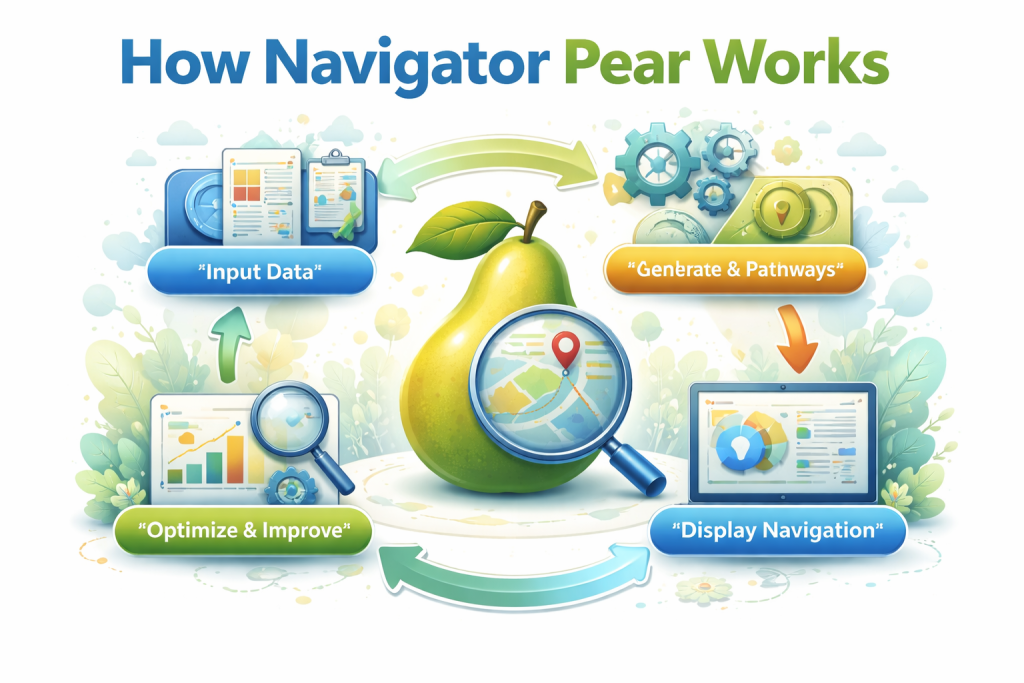
When treated as a system or framework, navigator pear follows a structured workflow.
Core Functional Components
A typical navigator pear-like system includes:
- Input layer (user or data entry)
- Processing layer (logic and routing)
- Output layer (visual or functional navigation)
Workflow or Operational Structure
Step-by-Step Process
- Data or user input is received
- System analyzes context and intent
- Navigation pathways are generated
- Output is displayed as structured guidance
Key Features and Capabilities
- Dynamic navigation paths
- Context-aware routing
- Scalable architecture
- Integration with analytics systems
Quick Summary:
- Works as a navigation + logic system
- Converts input into structured pathways
- Enhances efficiency and usability
Use Cases and Applications of Navigator Pear
Digital Navigation Systems
Navigator pear can function within:
- Websites
- Applications
- Dashboards
It helps users:
- Find information faster
- Navigate complex interfaces
- Reduce friction in user journeys
Data Organization and Mapping
In data systems, it can be used to:
- Structure large datasets
- Create logical relationships
- Improve accessibility
Business and Analytical Frameworks
Organizations may use similar systems for:
- Decision-making flows
- Workflow optimization
- Process mapping
User Experience Optimization
From a UX perspective, navigator pear supports:
- Clear navigation paths
- Reduced cognitive load
- Improved engagement
Pros and Cons Snapshot
| Pros | Cons |
|---|---|
| Improves navigation clarity | Ambiguous definition |
| Enhances user experience | Limited documentation |
| Scalable across systems | Requires contextual understanding |
Benefits of Using Navigator Pear
Efficiency Improvements
- Reduces time to locate information
- Streamlines workflows
- Minimizes user errors
Structured Navigation and Clarity
- Creates logical pathways
- Improves system usability
- Enhances accessibility
Scalability in Systems
- Adapts to growing datasets
- Supports complex architectures
Decision-Making Support
- Provides guided pathways
- Improves analytical processes
Limitations and Challenges
Ambiguity of Term Usage
- No standardized definition
- Context-dependent meaning
Learning Curve
- Requires understanding of system logic
- May confuse beginners
Limited Documentation
- Few verified references
- Lack of official frameworks
Industry-Specific Constraints
- Not universally applicable
- Depends on system design
Comparison Table: Navigator Pear vs Similar Concepts
| Feature | Navigator Pear | Traditional Navigation | Data Mapping Tools | UX Frameworks |
|---|---|---|---|---|
| Definition Clarity | Low | High | Medium | High |
| Flexibility | High | Medium | High | High |
| Use Case Range | Broad | Limited | Data-focused | UX-focused |
| Standardization | Low | High | Medium | High |
How to Identify the Correct Meaning of Navigator Pear
Context-Based Interpretation
- Analyze where the term appears
- Identify surrounding keywords
- Understand industry relevance
Industry Clues
- Tech context → navigation system
- Business context → workflow model
- UX context → user flow structure
Keyword Variations and Search Behavior
Users may search variations like:
- navigator system
- navigation framework
- data navigation tools
(Based on keyword clustering techniques…)
Related Concepts and Semantic Connections
- Navigation Systems
- Information Architecture
- Data Mapping
- User Experience (UX)
- System Design
Common Misunderstandings About Navigator Pear
Misinterpreting It as a Physical Product
- No verified physical product exists
Confusing It with Software Tools
- It may represent a concept, not a tool
Lack of Standard Definition
- Leads to inconsistent interpretations
Future Relevance and Trends
Growing Importance in Digital Systems
As systems become more complex:
- Navigation frameworks become essential
Role in AI and Automation
AI-driven systems increasingly rely on:
- Structured navigation
- Context-aware decision paths
Expansion Across Industries
Navigator pear-like concepts may expand into:
- Healthcare systems
- Financial analytics
- Enterprise platforms
Key Points
- Navigator pear is a context-dependent term
- Often linked to navigation and system structure
- Used in technology, UX, and data systems
- Requires context for accurate interpretation
- Supports efficiency and structured workflows
Maintenance, Implementation, and Optimization Strategies
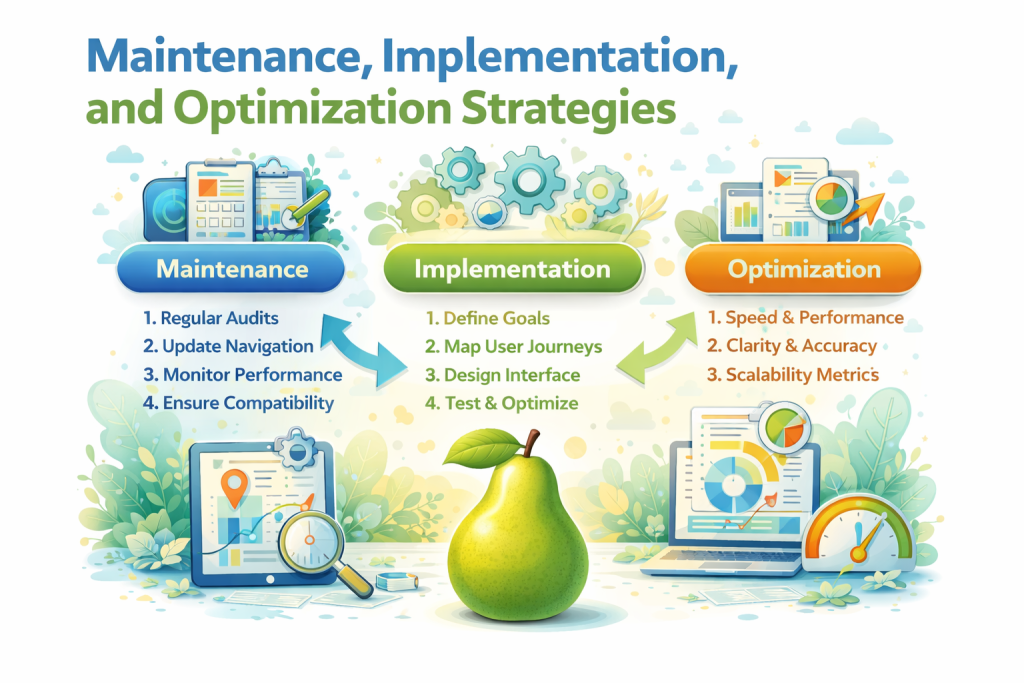
Practical Implementation in Digital Systems
To apply a structured navigation framework effectively, organizations must integrate it into both front-end interfaces and back-end logic systems. Implementation typically follows standardized system design practices used across modern platforms.
Step-by-Step Implementation Table
| Step | Action | Outcome |
|---|---|---|
| 1 | Define navigation goals | Clear structure and purpose |
| 2 | Map user journeys | Logical pathways established |
| 3 | Design interface layers | Improved usability |
| 4 | Integrate data systems | Real-time adaptability |
| 5 | Test and optimize | Performance improvement |
Key Insight:
Structured navigation systems are most effective when aligned with user intent and behavioral data (Based on UX optimization standards).
Performance Optimization Techniques
To maintain efficiency, systems must be continuously optimized using measurable metrics.
Core Optimization Factors
- Speed: Reduce loading and response times
- Clarity: Simplify navigation layers
- Accuracy: Ensure correct routing of information
- Scalability: Support growth without complexity
Metrics Used in Optimization
| Metric | Purpose |
|---|---|
| Bounce Rate | Measures navigation effectiveness |
| Session Duration | Indicates user engagement |
| Click Path Analysis | Tracks navigation flow |
| Conversion Rate | Evaluates system success |
Platforms developed by Google emphasize these metrics when evaluating navigation efficiency (According to web performance practices).
Maintenance Best Practices
Maintaining structured systems requires ongoing monitoring and updates.
Maintenance Checklist
- Regular system audits
- Updating navigation pathways
- Removing redundant layers
- Monitoring user behavior trends
- Ensuring compatibility with new technologies
Quick Summary:
- Continuous updates prevent system inefficiencies
- Data-driven decisions improve long-term performance
- Maintenance ensures consistent user experience
Advanced Use Cases Across Industries
Enterprise Systems and Workflow Automation
Large-scale organizations use structured navigation frameworks to:
- Automate workflows
- Standardize processes
- Improve internal communication
Enterprise Application Table
| Function | Application |
|---|---|
| Workflow Routing | Task automation |
| Decision Trees | Process optimization |
| Data Navigation | Information retrieval |
E-commerce Platforms
In e-commerce, structured navigation directly impacts:
- Product discovery
- User experience
- Conversion rates
Example Applications
- Category navigation systems
- Filter and sorting structures
- Personalized product recommendations
Data Insight:
Optimized navigation can significantly increase conversion rates (Based on e-commerce usability studies).
Data Analytics and Business Intelligence
In analytics environments, structured systems are used to:
- Organize dashboards
- Simplify complex datasets
- Enable faster decision-making
Tools developed by Microsoft often incorporate similar structured frameworks for data visualization and navigation (According to BI system standards).
Artificial Intelligence and Automation
AI systems rely heavily on structured pathways to:
- Process user inputs
- Generate outputs efficiently
- Improve decision accuracy
AI Integration Benefits
- Context-aware responses
- Adaptive navigation flows
- Predictive analysis
Expanded Comparison and Interpretation Guide
Interpretation Guide Table
| Context | Likely Meaning | Recommended Approach |
|---|---|---|
| Software Development | Navigation framework | Analyze system structure |
| UX Design | User flow model | Focus on usability |
| Data Systems | Mapping structure | Evaluate data relationships |
| Business Operations | Decision pathway | Assess workflow logic |
Feature Comparison Breakdown
| Feature | Structured Navigation Systems | Traditional Systems |
|---|---|---|
| Flexibility | High | Low |
| Adaptability | Dynamic | Static |
| User Focus | Strong | Limited |
| Scalability | High | Moderate |
Strategic Advantages in Modern Systems
Improved User Engagement
- Simplifies complex interfaces
- Enhances interaction quality
- Reduces user frustration
Data-Driven Decision Making
- Provides clear pathways
- Supports analytical processes
- Reduces uncertainty
Operational Efficiency
- Minimizes redundancy
- Streamlines workflows
- Improves productivity
Risks, Limitations, and Practical Constraints
Over-Complex System Design
- Excessive layers reduce usability
- Poor structuring leads to confusion
Misinterpretation of Concept
- Lack of standard definition creates inconsistency
- Users may apply incorrect frameworks
Resource Requirements
- Requires technical expertise
- Needs continuous monitoring and updates
Compatibility Issues
- May not integrate easily with legacy systems
- Requires adaptation for different industries
Best Practices for Effective Usage
Design Principles
- Keep navigation simple and intuitive
- Prioritize user intent
- Maintain logical hierarchy
Technical Guidelines
- Use scalable architecture
- Implement modular design
- Ensure system flexibility
Optimization Framework
- Monitor performance metrics
- Continuously refine pathways
- Align with user behavior data
Summary
Quick Implementation Guide:
- Define clear navigation goals
- Map structured pathways
- Optimize using performance metrics
- Maintain and update regularly
- Align with user behavior and intent
Conclusion
Navigator pear represents a flexible, context-driven concept primarily associated with structured navigation, system design, and data organization. Its meaning varies across industries, but its core value lies in improving clarity, efficiency, and usability in complex environments. Proper implementation requires context awareness, technical understanding, and continuous optimization.
FAQs
What does navigator pear actually mean?
It refers to a context-dependent concept often associated with structured navigation systems, frameworks, or data mapping approaches. Its meaning varies based on industry usage and application.
Is it a real tool or just a concept?
There is no widely verified standalone tool with this exact name. It is more commonly interpreted as a conceptual or framework-based term.
Where is it commonly used?
It is primarily relevant in technology, user experience design, data systems, and business process optimization.
Does it require technical knowledge?
Yes, understanding and implementing structured navigation systems typically requires basic to advanced technical knowledge depending on the use case.
How is it different from traditional navigation systems?
It is more flexible and context-driven, whereas traditional systems are usually fixed and less adaptable.
Can beginners use such frameworks?
Beginners can understand the basic concept, but practical implementation may require guidance and experience.
Why is it important in modern systems?
It helps manage complexity, improves user experience, and supports efficient data and workflow management.
References
Nielsen Norman Group
https://www.nngroup.com/articles/ Interaction Design Foundation
https://www.interaction-design.org/literature Google
https://developers.google.com/search/docs/fundamentals/seo-starter-guide Microsoft
https://learn.microsoft.com/en-us/ ISO 9241 Usability Standards
https://www.iso.org/standard/52075.html
