
The topic cowboys and bengals players focuses on analyzing two of the most followed NFL rosters: the Dallas Cowboys and the Cincinnati Bengals. Both teams feature elite-level talent at quarterback, wide receiver, and defensive positions, making them frequent subjects of comparison in NFL analysis, fantasy football research, and matchup breakdowns.
Understanding cowboys and bengals players is important because both teams represent different roster-building strategies:
- The Cowboys emphasize defensive pressure, balanced offense, and turnover creation.
- The Bengals rely on a pass-heavy offensive system built around quarterback precision and receiver chemistry.
This comparison helps fans and analysts evaluate:
- Player performance impact
- Team strengths and weaknesses
- Offensive and defensive efficiency
- Depth and star power balance
Cowboys and Bengals players include stars like Dak Prescott, CeeDee Lamb, and Micah Parsons for Dallas, while Cincinnati features Joe Burrow, Ja’Marr Chase, and Tee Higgins. The Cowboys focus on defense and balance, while the Bengals rely on a pass-heavy offense driven by elite quarterback-receiver chemistry.
Dallas Cowboys Players Overview
The cowboys and bengals players comparison starts with the Dallas Cowboys roster, which is built around defensive strength and offensive consistency. The Cowboys have multiple Pro Bowl-caliber players across key positions.
Key Offensive Players
The Cowboys’ offense is structured around quarterback control and wide receiver production.
Quarterback Leadership
- Dak Prescott leads the offense with experience and consistency.
- Strong in short-to-intermediate passing and situational decision-making.
Wide Receiver Unit
- CeeDee Lamb is the primary offensive weapon.
- Known for elite route running, separation ability, and high target share.
Running Game Structure
- Running backs like Tony Pollard (recent seasons) support offensive balance.
- Focus on outside runs and zone blocking schemes.
Offensive Line Importance
- One of the most stable units in the league.
- Plays a critical role in pass protection and run blocking efficiency.
Cowboys Offensive Breakdown Table
| Position | Player | Key Strength |
|---|---|---|
| QB | Dak Prescott | Leadership & accuracy |
| WR1 | CeeDee Lamb | Route running & separation |
| RB | Tony Pollard / rotation | Explosive runs |
| OL | Unit strength | Protection & stability |
Defensive Standouts
A major part of cowboys and bengals players analysis is Dallas’ elite defensive unit.
Micah Parsons – Defensive Star
- Elite pass rusher and linebacker hybrid
- Generates consistent pressure on quarterbacks
- One of the most disruptive defenders in the NFL
Trevon Diggs – Ball-Hawking Cornerback
- Known for interception ability and aggressive coverage style
- Forces quarterbacks to avoid targeting his side
Defensive Identity
- High pass-rush pressure rate
- Turnover-focused defensive strategy
- Flexible formations based on opponent offense
Cowboys Defensive Summary
- Elite edge pressure led by Micah Parsons
- Aggressive secondary built for interceptions
- Defensive scheme focuses on disruption and turnovers
Special Teams Performance
Special teams add depth to the Cowboys roster structure:
- Reliable field goal kicking consistency
- Strong punt coverage discipline
- Occasional game-changing return plays
Cowboys Team Identity in Player Context
Within cowboys and bengals players comparisons, Dallas stands out for:
- Defensive dominance as a primary strength
- Balanced offensive execution
- Reliance on star defensive playmakers
Also Discover Broncos v Browns: Match Result, Stats, Highlights & Full NFL Game Analysis
Cincinnati Bengals Players Overview
The Bengals roster in the cowboys and bengals players comparison is defined by elite passing offense and strong quarterback-receiver chemistry.
Key Offensive Players
The Bengals are one of the most pass-heavy teams in the NFL.
Quarterback
- Joe Burrow is the centerpiece of the offense.
- Elite accuracy, timing, and pocket awareness under pressure.
Wide Receiver Duo
- Ja’Marr Chase is the explosive deep-threat receiver.
- Tee Higgins provides size, strength, and contested catch ability.
Running Game Role
- Secondary component of the offense.
- Used mainly for balance and play-action support.
Bengals Offensive Breakdown Table
| Position | Player | Key Strength |
|---|---|---|
| QB | Joe Burrow | Accuracy & timing |
| WR1 | Ja’Marr Chase | Explosive plays |
| WR2 | Tee Higgins | Contested catches |
| RB | Committee | Supporting role |
Defensive Standouts
Defense plays a supporting but important role in cowboys and bengals players evaluations.
Trey Hendrickson – Pass Rush Leader
- Primary edge rusher
- Consistent quarterback pressure and sack production
Logan Wilson – Linebacker Leader
- Defensive communicator and tackling leader
- Strong in coverage and field awareness
Secondary Structure
- Zone-heavy defensive coverage schemes
- Focus on limiting explosive passing plays
Bengals Defensive Identity Box
- Strong edge rush presence
- Linebacker-led defensive coordination
- Zone coverage designed to limit big plays
Special Teams Contribution
Special teams support Bengals’ structured gameplay:
- Consistent kicking reliability
- Field position control strategy
- Reduced risk approach in returns
Bengals Team Identity in Player Context
In the cowboys and bengals players comparison, Cincinnati is defined by:
- Elite quarterback-driven offense
- High-volume passing system
- Receiver-dependent production model
Early Structural Comparison of Cowboys and Bengals Players
A key part of understanding cowboys and bengals players is their structural difference.
Offensive Structure Comparison
| Category | Cowboys | Bengals |
|---|---|---|
| Offensive Style | Balanced attack | Pass-heavy system |
| QB Role | Game manager + leader | System focal point |
| WR Dependency | Moderate | Very high |
| Run Game Usage | Strong | Limited |
Defensive Structure Comparison
| Category | Cowboys | Bengals |
|---|---|---|
| Pass Rush | Elite level | Strong |
| Turnovers | High focus | Situational |
| Coverage Style | Aggressive man/zone mix | Zone-based system |
Key Insight
The cowboys and bengals players comparison shows two completely different roster philosophies:
- Cowboys rely on defense and balanced offense
- Bengals rely on elite passing execution and receiver dominance
Key Points
- Cowboys and Bengals players represent two different NFL roster philosophies
- Dallas is defense-led with elite pass rush from Micah Parsons
- Cincinnati is offense-led with Joe Burrow–Ja’Marr Chase connection
- Both teams feature top-tier wide receivers and Pro Bowl-level talent
- Offensive structure is the biggest difference between the two teams
Summary
The cowboys and bengals players analysis highlights two contrasting NFL team identities. The Cowboys are built around defensive strength and balanced offensive execution, while the Bengals depend heavily on a high-efficiency passing system led by Joe Burrow and elite receivers. These structural differences define how each team performs across the NFL season.
Cowboys and Bengals Players – Head-to-Head Comparison
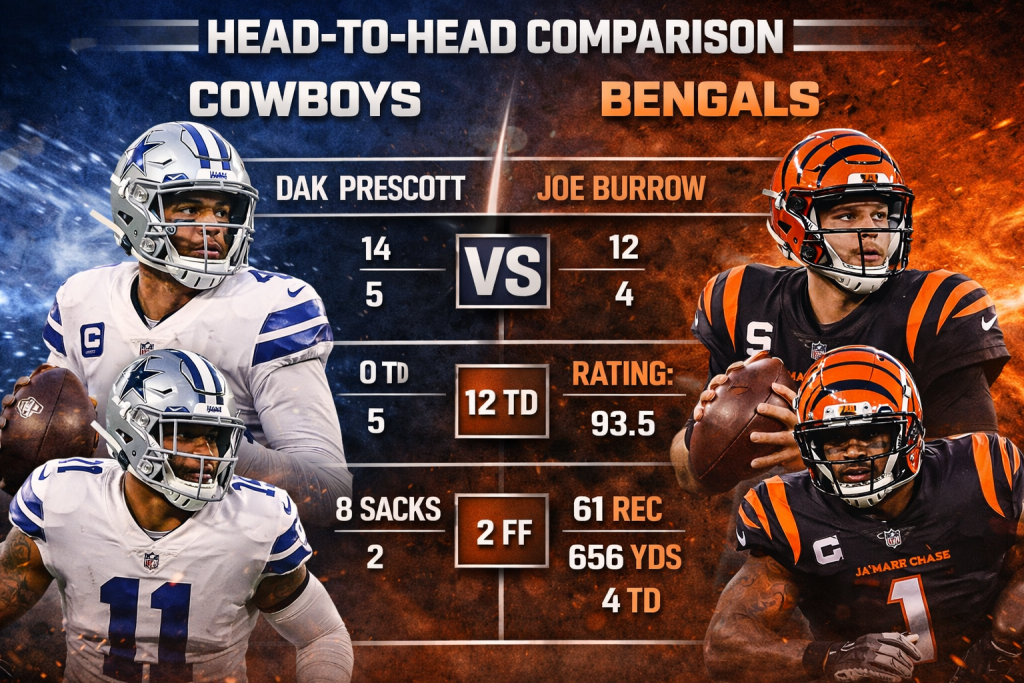
The cowboys and bengals players comparison becomes more insightful when evaluating position-by-position strength. Both the Dallas Cowboys and Cincinnati Bengals feature elite talent, but their roster construction leads to different performance outcomes.
Quarterback Comparison – Dak Prescott vs Joe Burrow
Leadership and Playing Style
| Player | Team | Style |
|---|---|---|
| Dak Prescott | Cowboys | Balanced, risk-managed passer |
| Joe Burrow | Bengals | High-volume precision passer |
- Dak Prescott focuses on efficiency, game control, and minimizing turnovers.
- Joe Burrow is a high-usage quarterback with elite timing and aggressive downfield reads.
Performance Traits
- Prescott excels in short-to-intermediate throws and red-zone management
- Burrow excels in pressure situations and deep passing accuracy
- Both quarterbacks are franchise leaders with playoff-level experience
Wide Receiver Unit Comparison
Cowboys WR Core
- CeeDee Lamb is the primary target and offensive centerpiece
- Strong route running and yards-after-catch ability
- Secondary receivers provide rotational support rather than elite depth
Bengals WR Core
- Ja’Marr Chase is an elite deep-threat and separation receiver
- Tee Higgins is one of the best contested-catch receivers in the league
- Bengals have one of the strongest WR duos in the NFL
WR Comparison Table
| Category | Cowboys | Bengals |
|---|---|---|
| WR1 | CeeDee Lamb | Ja’Marr Chase |
| WR2 | Mixed rotation | Tee Higgins |
| Depth | Moderate | Strong |
| Explosiveness | High | Very high |
Running Game and Offensive Balance
Cowboys Running Attack
- Uses structured run schemes to support passing game
- Running backs provide balance and clock control
- Offensive line strength improves rushing efficiency
Bengals Running Attack
- Secondary offensive priority
- Used mainly for play-action setup
- Less volume compared to passing game
Defensive Leaders Comparison
Cowboys Defensive Strength
- Micah Parsons leads elite pass rush pressure
- Trevon Diggs adds interception capability
- Defense focuses on creating turnovers and field position advantages
Bengals Defensive Strength
- Trey Hendrickson leads consistent sack production
- Logan Wilson anchors linebacker communication
- Defense prioritizes zone coverage discipline
Defensive Comparison Table
| Category | Cowboys | Bengals |
|---|---|---|
| Pass Rush Leader | Micah Parsons | Trey Hendrickson |
| Secondary Strength | Aggressive | Structured |
| Turnover Creation | High | Moderate |
| Scheme Style | Pressure-based | Zone coverage |
Team Performance Style Analysis
Cowboys Playing Style
The cowboys and bengals players comparison highlights Dallas as:
- A defense-driven team with explosive play capability
- Strong in creating turnovers and field pressure
- Balanced offense designed around efficiency
Bengals Playing Style
Cincinnati is defined by:
- High-volume passing offense
- Quarterback-receiver chemistry dominance
- Reliance on explosive offensive drives
Historical Matchups – Cowboys vs Bengals
Head-to-Head Overview
- Matchups between these teams are relatively infrequent
- Games are often competitive due to balanced roster talent
- Momentum swings usually depend on quarterback performance
Key Matchup Patterns
- Bengals perform better in high-tempo passing games
- Cowboys perform better when defensive pressure dominates
- Turnovers often decide game outcomes
Advanced Statistical Comparison (Team-Level Insights)
| Metric | Cowboys | Bengals |
|---|---|---|
| Passing Efficiency | High | Very high |
| Rushing Production | Balanced | Low |
| Defensive Sacks | Elite | Strong |
| Turnover Differential | Positive tendency | Moderate |
| Red Zone Efficiency | Strong | Strong |
Fantasy Football Impact of Cowboys and Bengals Players
High-Value Fantasy Players
Cowboys
- CeeDee Lamb – WR1 elite production
- Dak Prescott – QB2/QB1 borderline
- Micah Parsons – IDP elite defender
Bengals
- Joe Burrow – high-ceiling QB
- Ja’Marr Chase – top-tier WR1
- Tee Higgins – strong WR2 value
Fantasy Strategy Insights
- Bengals players offer higher weekly ceiling due to passing volume
- Cowboys players offer more stability and defensive scoring options
- WRs from both teams are high-priority fantasy picks
People Also Ask
Q1: Who are the key players in Cowboys and Bengals teams?
The Cowboys feature Dak Prescott, CeeDee Lamb, and Micah Parsons, while the Bengals rely on Joe Burrow, Ja’Marr Chase, and Tee Higgins as their core star players.
Q2: Which team has a stronger offense, Cowboys or Bengals?
The Bengals have a stronger passing offense, while the Cowboys have a more balanced offensive structure with better run-game integration.
Q3: Who is better, Joe Burrow or Dak Prescott?
Joe Burrow is generally considered more pass-heavy and aggressive, while Dak Prescott focuses on efficiency and game management.
Q4: Which team has better wide receivers?
The Bengals have a stronger overall WR duo with Ja’Marr Chase and Tee Higgins, while the Cowboys rely heavily on CeeDee Lamb.
Summary Points
- Cowboys and Bengals players represent two contrasting NFL systems
- Cowboys rely on defense-led game control and balanced offense
- Bengals rely on elite quarterback-receiver passing chemistry
- Micah Parsons and Trey Hendrickson lead defensive pressure units
- Ja’Marr Chase and CeeDee Lamb are top-tier NFL wide receivers
Conclusion
The cowboys and bengals players comparison highlights two elite but structurally different NFL teams. The Cowboys are built on defensive dominance, turnovers, and balanced offense, while the Bengals depend on high-volume passing led by Joe Burrow and elite receiver production. Both teams feature Pro Bowl-level talent, but their success depends on completely different strategic identities.
FAQs
1. Who are the best Cowboys and Bengals players?
Dak Prescott, CeeDee Lamb, Micah Parsons, Joe Burrow, Ja’Marr Chase, and Tee Higgins are the top players.
2. What makes Bengals players unique?
Their offensive system is heavily pass-focused and built around elite quarterback-receiver chemistry.
3. What makes Cowboys players strong?
Strong defense, elite pass rush, and balanced offensive execution define their roster.
4. Which defense is better?
The Cowboys generally have a stronger pass rush unit, while Bengals rely more on structured coverage.
5. Are Cowboys and Bengals offensive styles similar?
No, Cowboys are balanced, while Bengals are pass-heavy.
6. Who is the best defensive player in the matchup?
Micah Parsons is widely considered the most dominant defensive player in this comparison.
References
Official NFL & Team Sources
- https://www.nfl.com/teams/dallas-cowboys/roster/
- https://www.nfl.com/teams/cincinnati-bengals/roster/
- https://www.nfl.com/players/
- https://www.nfl.com/stats/
Advanced Stats & Player Analytics
- https://www.pro-football-reference.com/teams/dal/
- https://www.pro-football-reference.com/teams/cin/
- https://www.pro-football-reference.com/players/
- https://nextgenstats.nfl.com/
