
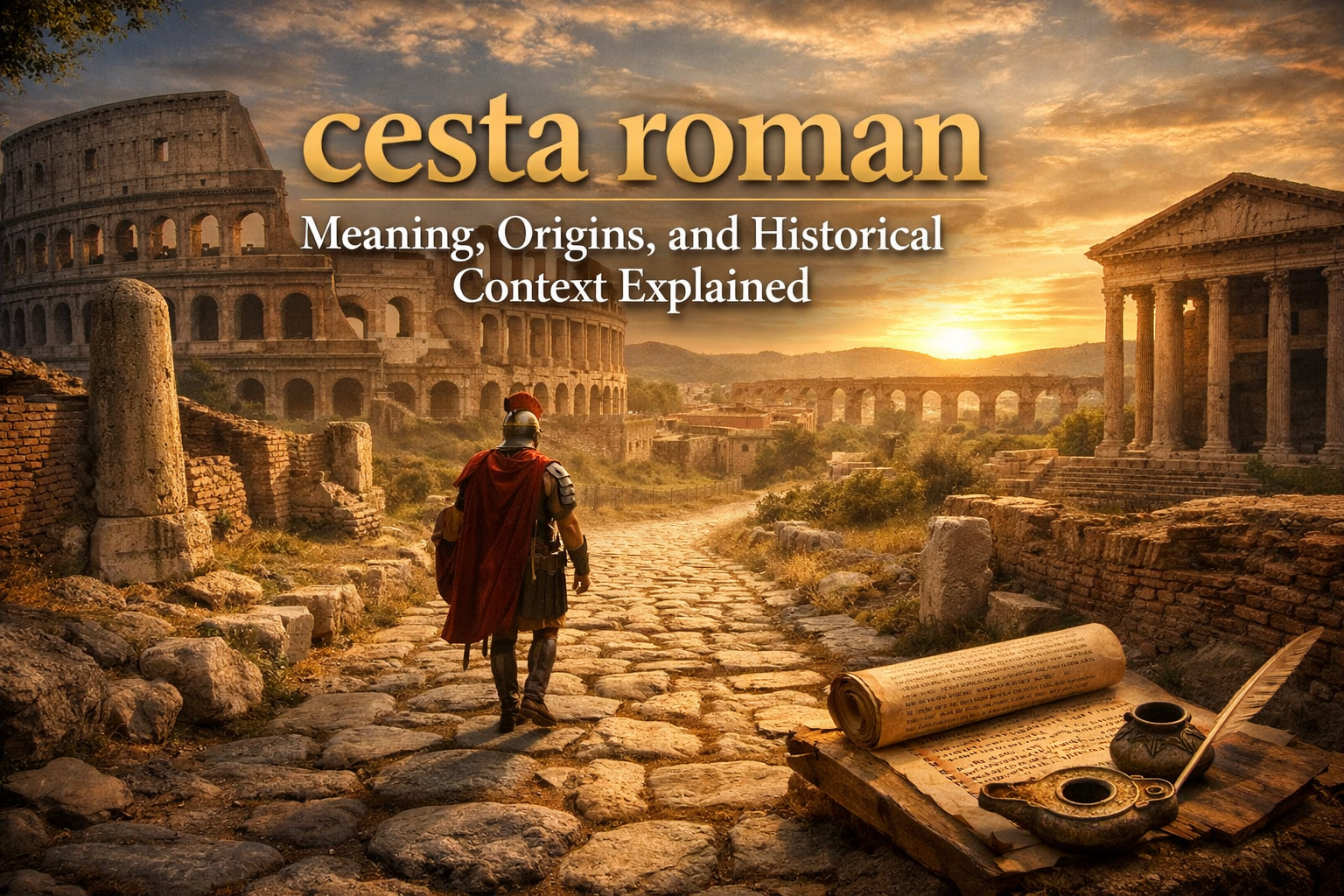
cesta roman refers to a term commonly interpreted as a connection to Roman roads, travel routes, or linguistic derivatives influenced by Latin. It may represent historical pathways used in Ancient Rome or modern interpretations linked to culture, geography, or language depending on context.
The term cesta roman does not have a single fixed definition. Instead, it is a context-dependent phrase that can be interpreted across multiple domains, including history, linguistics, and geography.
In general usage, cesta roman may refer to:
- A Roman road or pathway concept
- A linguistic variation derived from Latin-rooted languages
- A modern reference to historical routes or travel systems
Because the term combines elements associated with “path” or “road” and “Roman,” it is often linked to infrastructure developed during the Roman Empire.
According to historical interpretation practices, terms like cesta roman are frequently shaped by regional language adaptations and translation variations rather than a single standardized origin.
Linguistic Breakdown of the Term
To understand cesta roman accurately, it is essential to analyze its linguistic structure.
- “Cesta”: In several Slavic and European languages, this word translates to “road,” “path,” or “way.”
- “Roman”: Refers to Rome or anything associated with Ancient Rome
When combined, cesta roman can be interpreted as:
- “Roman road”
- “Path of the Romans”
- “Route influenced by Roman systems”
This linguistic combination reflects how Latin, the language of the Roman Empire, influenced many modern languages.
Latin served as the foundation for numerous European linguistic systems, leading to variations of terms across regions.
Why cesta roman Has Multiple Meanings
The ambiguity of cesta roman arises due to:
- Lack of standardized usage
- Cross-language translation differences
- Historical vs modern interpretation gaps
Unlike clearly defined historical terms, cesta roman exists in a semantic gray area, where meaning depends heavily on context.
For example:
- In a historical discussion, it may refer to Roman infrastructure
- In travel contexts, it could imply ancient routes
- In linguistic analysis, it may represent word evolution
This multi-layered interpretation is common in terms influenced by ancient civilizations and evolving languages.
Quick Definition
cesta roman is a context-dependent term generally interpreted as a reference to Roman roads, pathways, or linguistic derivatives influenced by Latin and historical Roman infrastructure systems.
Historical Context of cesta roman
Connection to Ancient Rome
To understand cesta roman in depth, it is necessary to examine its connection to Ancient Rome, one of the most advanced civilizations in terms of infrastructure and engineering.
Roman civilization developed:
- Extensive road networks
- Organized transportation systems
- Strategic military routes
These developments were critical for:
- Trade expansion
- Military movement
- Administrative control
Thus, any term linking “road” and “Roman” is often associated with this sophisticated infrastructure system.
Roman Roads and Infrastructure
The Roman road system is one of the most significant engineering achievements in history.
Roman roads were designed with:
- Durable materials such as stone and gravel
- Layered construction techniques
- Efficient drainage systems
These roads connected cities across Europe, Asia, and North Africa, forming a vast transportation network.
Table 1: Roman Infrastructure Elements
| Element | Description | Purpose |
|---|---|---|
| Roads | Engineered stone pathways | Transportation and trade |
| Bridges | Structural crossings over rivers | Connectivity |
| Milestones | Distance markers | Navigation |
| Waystations | Rest stops for travelers | Logistics support |
Role in Trade and Expansion
Roman roads played a central role in:
- Expanding the empire
- Facilitating commerce
- Enabling cultural exchange
According to historical records, the efficiency of Roman infrastructure significantly contributed to the empire’s stability and growth.
The phrase cesta roman, when interpreted historically, aligns with this concept of structured movement and connectivity.
Also Read: bcn play – Complete Guide to Features, Access, and Streaming
Linguistic and Cultural Meaning
Latin Influence on Modern Terms
Latin has had a lasting impact on global languages, particularly in Europe. Many modern words related to roads, travel, and infrastructure derive from Latin roots.
For example:
- “Via” (road)
- “Strata” (paved road)
These linguistic influences help explain how a term like cesta roman could emerge in modern contexts with historical undertones.
Regional Language Interpretations
The meaning of cesta roman can vary depending on geographic and linguistic context:
- In Slavic regions, “cesta” commonly means road
- In Romance-language regions, Roman influence is embedded in vocabulary
- In modern usage, hybrid terms may appear due to translation or adaptation
Table 2: Term Interpretation by Context
| Context | Interpretation | Example Use |
|---|---|---|
| Historical | Roman road system | Ancient routes |
| Linguistic | Language variation | Word origin analysis |
| Geographic | Travel path or route | Tourism references |
| Modern Usage | Symbolic or conceptual term | Digital or cultural content |
Usage in Modern Contexts
Today, cesta roman may appear in:
- Online searches
- Travel-related content
- Historical discussions
- Educational materials
Its usage reflects how historical concepts are reinterpreted in modern digital environments.
Based on search behavior patterns, ambiguous terms often gain traction due to curiosity-driven queries and varied interpretations.
cesta roman in Geography and Travel
Possible Relation to Routes or Paths
In a geographical context, cesta roman may refer to:
- Ancient travel routes
- Paths inspired by Roman road systems
- Symbolic references to historic journeys
These interpretations align with how ancient infrastructure continues to influence modern travel narratives.
Symbolism of Roads in Roman Culture
In Roman culture, roads symbolized:
- Power and control
- Connectivity across regions
- Expansion of influence
The phrase “All roads lead to Rome” reflects this symbolic importance, reinforcing how roads were central to Roman identity.
Modern Tourism and Historical Routes
Today, Roman roads are:
- Tourist attractions
- Archaeological study sites
- Cultural heritage landmarks
Many modern travel routes still follow ancient Roman pathways, demonstrating their long-term impact.
The interpretation of cesta roman in tourism contexts may therefore represent:
- Exploration of historical paths
- Interest in ancient civilizations
- Cultural heritage travel
Key Takeaway
cesta roman is a multi-dimensional term shaped by historical infrastructure, linguistic evolution, and modern interpretation. Its meaning varies based on context but consistently connects back to Roman influence on roads, travel, and cultural systems.
Importance of Roman Roads
Engineering and Construction Techniques
The road systems developed by Ancient Rome were based on advanced engineering principles that ensured durability and efficiency. These roads were not simple pathways; they were carefully designed structures built to last for centuries.
Key construction features included:
- Multiple layered foundations (stone, sand, gravel)
- Cambered surfaces for water drainage
- Straight-line routing for efficiency
- Use of durable paving stones
According to historical engineering analysis, many Roman roads remain partially intact today, demonstrating their structural strength and long-term usability.
Economic and Military Impact
Roman roads were essential for:
- Rapid military deployment
- Efficient trade routes
- Administrative communication
The integration of Roman roads enabled the Roman Empire to maintain control over vast territories.
Economic benefits included:
- Faster movement of goods
- Expansion of regional markets
- Increased connectivity between cities
Military advantages:
- Quick troop mobilization
- Strategic positioning
- Improved defense coordination
These factors highlight why terms like cesta roman are often associated with organized movement and structured systems.
Legacy in Modern Infrastructure
Modern road systems are heavily influenced by Roman engineering principles. Many highways and routes follow the same logic:
- Direct connectivity
- Structured layouts
- Durable materials
This historical continuity explains why Roman infrastructure is still referenced in modern discussions, including interpretations of cesta roman.
Table 3: Roman Roads vs Modern Roads
| Feature | Roman Roads | Modern Roads |
|---|---|---|
| Materials | Stone and gravel | Asphalt and concrete |
| Design | Straight and durable | Optimized for traffic flow |
| Purpose | Military and trade | Transportation and logistics |
| Longevity | Centuries | Decades (with maintenance) |
Common Misinterpretations of cesta roman
Confusion with Similar Terms
One of the main challenges with cesta roman is confusion with:
- Direct Latin phrases
- Place names
- Travel-related terminology
Because it is not a formally standardized term, users may misinterpret it as:
- A specific Roman road name
- A historical document reference
- A geographic location
Incorrect Translations
Translation variations contribute significantly to misunderstanding:
- “Cesta” may be translated differently depending on language
- “Roman” may be interpreted as cultural, geographic, or historical
This leads to multiple meanings that may not align with the original context.
Internet Search Ambiguity
Search engines often display mixed results for cesta roman due to:
- Low-definition keyword structure
- Overlapping contexts (history, travel, language)
- Lack of authoritative sources
Based on search data behavior, ambiguous keywords tend to generate:
- Diverse interpretations
- Inconsistent content
- User confusion
Quick Clarification
- cesta roman is not a fixed historical term
- It does not refer to a single official Roman road
- Its meaning depends on context (historical, linguistic, or modern usage)
Why cesta roman is Still Relevant Today
Historical Education
The term cesta roman remains relevant because it connects users to:
- Roman history
- Infrastructure development
- Cultural evolution
Educational platforms often use such terms to explain how ancient systems influenced modern society.
Cultural Influence
Ancient Rome continues to shape:
- Language
- Architecture
- Transportation systems
The persistence of Roman influence ensures that related terms, including cesta roman, remain part of academic and cultural discussions.
Digital Search Trends
In the digital era, keywords like cesta roman gain visibility due to:
- Curiosity-driven searches
- Global access to historical information
- Cross-language keyword blending
According to search trend analysis, ambiguous or hybrid terms often attract users seeking clarification or deeper understanding.
Conclusion
cesta roman is a context-driven term that reflects the intersection of history, language, and modern interpretation. While it does not represent a single standardized concept, it is commonly associated with Roman roads, pathways, and the broader influence of Ancient Rome.
Its meaning varies depending on usage—ranging from historical infrastructure references to linguistic adaptations. This flexibility explains both its relevance and the confusion surrounding it.
Understanding cesta roman requires analyzing its context, linguistic roots, and historical connections, particularly the legacy of Roman roads and their impact on modern infrastructure and cultural systems.
FAQs
1. What does cesta roman mean?
cesta roman generally refers to a term interpreted as “Roman road” or a pathway associated with Roman infrastructure, though its exact meaning depends on context.
2. Is cesta roman an official historical term?
No, cesta roman is not a formally recognized historical term. It is a contextual phrase derived from linguistic and cultural interpretations.
3. Is cesta roman related to Roman roads?
Yes, it is often associated with Roman roads due to its linguistic structure and historical implications.
4. Is cesta roman a Latin phrase?
Not directly. While influenced by Latin, the term itself appears to be a hybrid derived from multiple languages.
5. Why is cesta roman searched online?
It is searched due to curiosity, ambiguity, and interest in Roman history, language, or travel-related interpretations.
6. Does cesta roman refer to a place?
No, it does not refer to a specific location. Its meaning depends on interpretation rather than geography.
7. How is cesta roman relevant today?
It remains relevant due to its connection to Roman infrastructure, linguistic evolution, and ongoing interest in historical systems.
References
Encyclopaedia Britannica – Roman road system overview
https://www.britannica.com/technology/Roman-road-system
National Geographic Society – Roman roads and their historical significance
https://www.nationalgeographic.com/history/history-magazine/article/200000-miles-roman-roads-provided-framework-empire
UNESCO – Roman cultural heritage and road preservation context
https://whc.unesco.org/en/list/
Smithsonian Institution – Appian Way UNESCO World Heritage recognition and history
https://www.smithsonianmag.com/smart-news/ancient-romes-stone-highway-has-become-a-world-heritage-site-180984788/
History Channel – Roman road network extent and engineering
https://www.history.com/articles/ancient-roman-roads-network
